Decompose or Execute
Every active subgoal is either refined into ordered children or grounded as one atomic action.
Build the plan as the environment unfolds: decompose, execute, remember, and replan from the latest state.
Replanning in action. When the low-level action stalls, AtomTree returns to the parent subgoal and regenerates its subtree using the latest state and memory.
AtomTree incrementally constructs an explicit goal tree. At each active node, the LLM sees the current subgoal, symbolic state, and memory, then chooses whether to decompose the goal or execute one grounded action.
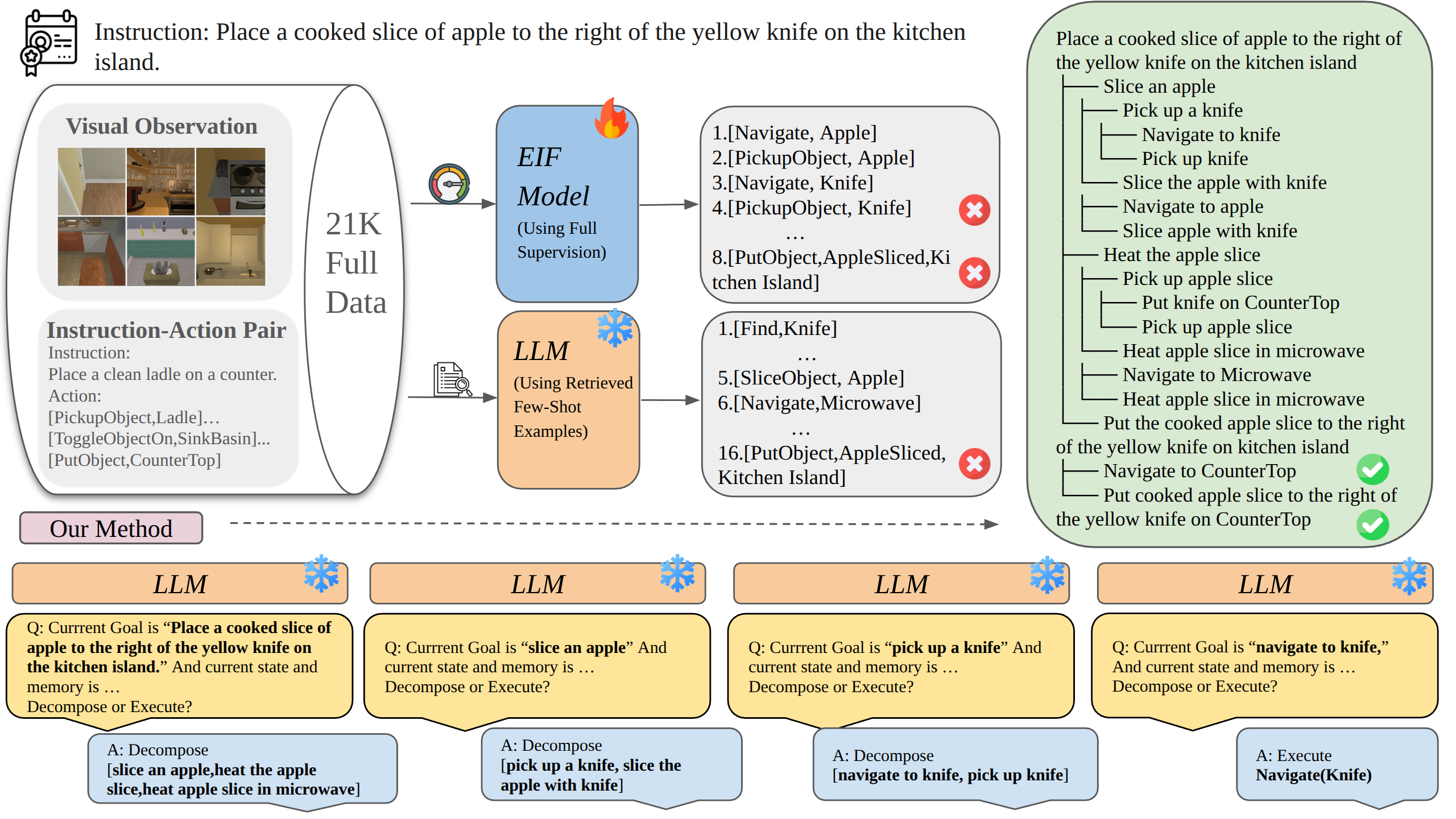
Every active subgoal is either refined into ordered children or grounded as one atomic action.
Seen objects and action outcomes preserve long-horizon context without replaying the full trace.
A failed or stalled action sends planning back to its parent, where a revised subtree is generated.
ALFRED's public test release omits the hidden task_type and pddl_params, preventing direct local evaluation on Test Seen and Test Unseen. We use an LLM through codex exec to recover these goal specifications from the public language instructions.
View reconstructed test labels ↗Method development and parameter selection use only the public validation splits. These reconstructed goals are used only for AtomTree's final local evaluation on Test Seen and Test Unseen; the test splits are not used for tuning. They are unofficial inferred labels, not official ALFRED test ground truth. Many remaining mismatches involve ambiguity or noise in the human-written annotations and canonical target names.
On ALFRED, AtomTree achieves the highest reported Success Rate among the compared zero-shot methods on all four splits, while using only the high-level goal instruction.
Test Success Rate (%) · Socratic-Planner and AtomTree both operate zero-shot.
The featured tomato rollout above shows replanning. These four additional rollouts show memory, grounded object interaction, multi-object progress, and another long-horizon recovery.
Recorded outcomes keep the planner aligned after cleaning so it can advance to placement.
The hierarchical goal is progressively refined into executable navigation and interaction actions.
Separate subgoals preserve progress across two object instances until both are placed.
Updated state and memory support a revised subtree when execution can no longer progress.
@inproceedings{zhai2026atomtree,
  title  = {AtomTree: A Hierarchical Framework for State-Aware
            Embodied Instruction Following with LLMs},
  author = {Zhai, Haotian and Sha, Tianming and Li, Junnan},
  year   = {2026}
}