αUniversity of MinnesotaβNational University of SingaporeγUniversity of Illinois Urbana-ChampaignδUniversity of Southern CaliforniaεUniversity of PennsylvaniaζMohamed bin Zayed University of Artificial Intelligence
TL;DR
GDPO tells a multi-reward learner which rewards a response earned; MRTPO also tells it which tokens earned
each of them. For each reward, the policy replays its own response with and without that reward's verifier information,
and the per-token Jensen–Shannon distance between the two next-token distributions decides where that reward's advantage
goes. No auxiliary model, no token labels, no extra generation.
6 / 6
models with the best average, across text-to-SQL, instruction following and tool calling
97% vs 2%
BFCL cases in the required tool-call format after 10 training steps, MRTPO vs GDPO
40%
shorter text-to-SQL responses than GDPO's (Qwen2.5-Coder-3B)
0
auxiliary models, token labels or extra generations
01 · The problem
🎯 One wrong token, and the penalty lands everywhere
Language models are increasingly trained against several verifiable rewards at once: the correctness and the format of a tool
call, or the individual constraints of a complex instruction. GDPO normalizes each reward separately, so different reward
combinations keep distinct advantages. But in GRPO, GDPO and SAW, every token of a response shares one advantage.
A verifier checks only a few positions. The penalty for one wrong token is spread over the whole response, where it can be
outweighed by the credit other rewards put on the same tokens.
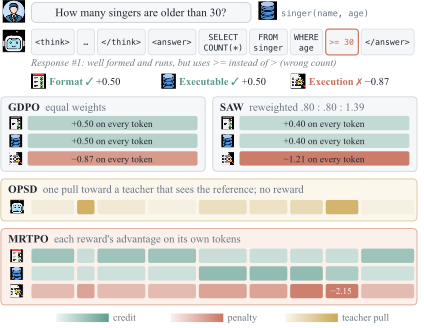
One SQL response that is well formed and executable but uses >= for >.
GDPO and SAW put each reward's advantage on every token; OPSD pulls toward a teacher; MRTPO puts format credit on the tags,
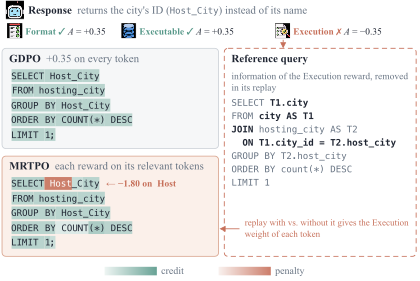
executability credit on the query, and the execution penalty mostly on >= 30.Per-token advantage on a response that returns the city's ID instead of its name. GDPO spreads every reward
evenly; MRTPO puts the execution penalty on Host.
02 · Method
💡 Let each verifier's information point to its tokens
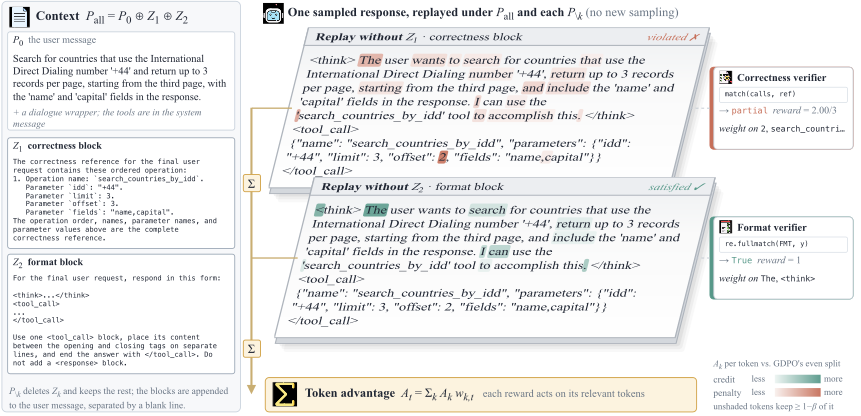
MRTPO assigns the advantage of each reward to the tokens relevant to it, using the information its verifier checks.
Write each verifier's information as a text block
\(Z_k\) is what reward \(k\) checks: the format rule, the response's own SQLite error, the reference query, or one
constraint of the instruction. \(P_{\text{all}} = P_0 \oplus\) all blocks; \(P_{\setminus k}\) leaves out \(Z_k\).
When the information is already in the prompt (instruction constraints), \(P_{\text{all}}\) is the prompt and
\(P_{\setminus k}\) removes one constraint. Sampling still uses \(P_0\).
Replay the response under both contexts
The sampling policy reads its own response once under each context, one forward pass per context, with no new
generation. At every token \(t\), the Jensen–Shannon distance \(q_{k,t}\) between the two next-token distributions
measures how relevant that token is to reward \(k\).
Move each reward's advantage to its tokens
The distances become per-token weights, and each token's advantage is the weighted sum over rewards. The weights
average to 1 per response, so every response keeps its GDPO credit; only the placement changes.
\(A_k\): GDPO's group-normalized advantage of reward \(k\) for the response; \(\bar q_k\): mean of
\(q_{k,t}\) over the response; \(\beta = 0.5\). \(S_t\) is then divided by GDPO's batch standard deviation.
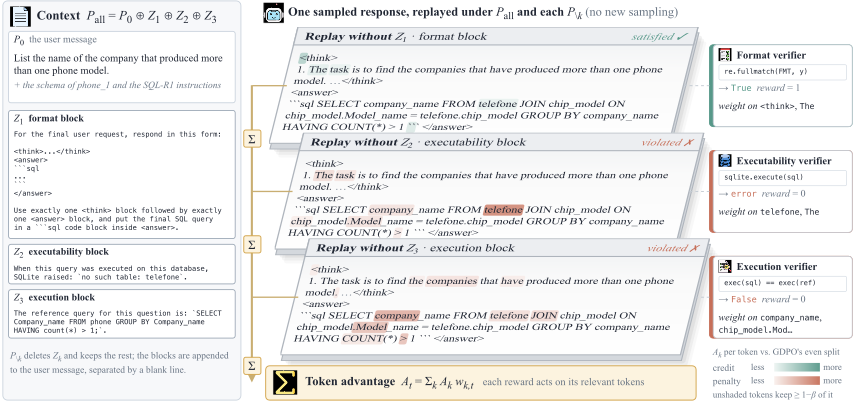
Self-replay on a text-to-SQL response that reads table telefone, which does not exist. Each replay
removes one verifier block; the shading shows where that reward's advantage goes.
What changes compared with GDPO
Method
What changes in the GDPO step
Token advantage \(S_t^{(j)}\)
GDPO
nothing; the per-reward advantages are summed
\(\sum_k A_k^{(j)}\)for all \(t\)
SAW
each reward is weighted by its coefficient of variation in the batch
\(\sum_k \lambda_k A_k^{(j)}\)for all \(t\)
DARA
rewards that vary in fewer groups get a larger, capped weight on their positive advantages
\(\sum_k \bigl(A_k^{(j)} + (\lambda_k - 1)[A_k^{(j)}]_+\bigr)\)for all \(t\)
DVAO
each reward is weighted by its standard deviation within the group, normalized across rewards
\(\sum_k \lambda_k A_k^{(j)}\)for all \(t\)
SA-MRPO
each reward is discounted by how saturated it is in the batch
\(\sum_k \lambda_k A_k^{(j)}\)for all \(t\)
GD²PO
responses whose per-reward advantages disagree in sign are dropped, and each prompt is scaled by its share of kept responses
\(\kappa\,\delta^{(j)} \sum_k A_k^{(j)}\)for all \(t\)
RVPO
the rewards are combined by a soft minimum, which penalizes their variance
\(\operatorname{softmin}_k A_k^{(j)}\)for all \(t\)
MRTPO
each reward's advantage is assigned to tokens by relevance
\(\sum_k A_k^{(j)}\, w_{k,t}\)
The other methods act on the response, so every token of a response gets the same advantage. MRTPO sets a
weight per reward and token and can be combined with them.
GDPO step
Sample a group of responses from \(P_0\) and score every reward
Normalize each reward within the group: \(A_k\)
Sum the rewards: \(S=\sum_k A_k\), the same on every token
Divide by the batch standard deviation and update the policy
MRTPO step
Sample a group of responses from \(P_0\) and score every reward
Normalize each reward within the group: \(A_k\)
For each reward \(k\), find its relevant tokens: replay \(y\) after \(P_{\text{all}}\) and after
\(P_{\setminus k}\); \(q_{k,t}\) = JS distance of the two predictions;
\(w_{k,t}=(1-\beta)+\beta\,q_{k,t}/\bar q_k\)
Sum the rewards on each token: \(S_t=\sum_k A_k\, w_{k,t}\)
Divide by the batch standard deviation and update the policy
CostA training step takes 10–20% longer than GDPO. Replay only
runs for rewards that vary within the group, so only 12–21% of response–reward pairs need one.
03 · Results
📊 Best average on all three tasks and all six models
Text-to-SQL
Method
Spider
BIRD
Avg.
Dev
Test
Syn
Realistic
DK
Dev
Qwen2.5-Coder-3B-Instruct
Base
62.38
64.46
53.00
54.72
51.87
36.88
53.88
GRPO
74.24±1.26
75.00±0.31
65.92±1.50
69.49±1.94
64.04±1.69
43.54±1.03
65.37±1.18
GDPO
76.66±2.21
76.40±1.17
67.34±1.82
70.80±1.94
65.61±0.93
47.13±1.94
67.32±1.66
OPSD
68.18±0.61
69.34±0.45
59.15±0.39
62.14±1.38
56.12±0.96
39.21±0.70
59.02±0.49
MRTPO
78.24±0.44
76.79±0.43
68.67±0.86
73.49±0.61
68.17±1.53
46.26±0.87
68.60±0.15
GDPO+SAW
74.63±0.06
74.77±0.86
65.60±1.03
70.60±2.08
64.67±0.58
45.23±1.28
65.92±0.93
MRTPO+SAW
78.88±0.44
77.67±0.23
68.86±0.54
73.49±0.57
67.92±0.66
46.95±0.93
68.96±0.19
Qwen2.5-Coder-7B-Instruct
Base
77.18
77.55
68.67
73.62
67.04
51.63
69.28
GRPO
78.30±0.78
81.03±0.49
71.44±0.44
73.89±0.79
66.91±0.66
54.00±0.63
70.93±0.32
GDPO
79.21±0.68
80.62±0.49
72.21±0.73
74.87±0.82
67.29±0.54
55.11±1.26
71.55±0.27
OPSD
79.11±0.44
80.39±0.52
70.76±1.45
75.72±0.97
69.10±0.49
53.87±0.36
71.49±0.54
MRTPO
81.33±0.42
81.65±0.45
73.53±0.48
75.92±1.78
70.04±1.79
56.42±0.46
73.15±0.19
GDPO+SAW
79.92±0.46
81.32±0.47
72.24±0.98
76.31±0.12
68.23±1.56
55.44±1.18
72.24±0.35
MRTPO+SAW
81.08±0.31
81.39±0.15
73.21±1.12
77.23±0.99
70.04±0.19
57.53±0.32
73.41±0.35
Execution accuracy (%), mean ± standard deviation over 3 seeds.
Instruction following
Method
IFEval
IFBench
MulDimIF
AdvancedIF
Avg.
Prompt
Inst.
Prompt
Inst.
Acc.
Overall
Rubric
Qwen3-4B-Instruct-2507
Instruct
83.77
88.82
30.95
33.13
56.50
38.21
76.41
58.26
GRPO
85.44±0.15
90.16±0.06
35.68±1.02
37.79±1.01
62.44±0.86
39.27±0.27
77.06±0.12
61.12±0.34
CoRT
85.37±0.50
90.06±0.31
34.74±1.90
36.85±1.95
63.00±1.35
38.88±0.39
76.95±0.44
60.84±0.78
GDPO
85.52±0.52
90.23±0.33
36.39±1.59
38.84±1.18
62.88±2.83
38.91±0.43
76.85±0.21
61.37±0.77
MRTPO
85.66±1.20
90.40±0.74
38.76±1.53
40.92±1.33
65.37±1.33
39.39±0.61
77.25±0.15
62.54±0.32
Qwen2.5-7B-Instruct
Instruct
72.09
79.50
26.53
29.37
50.77
23.51
69.26
50.15
GRPO
81.72±0.31
87.42±0.16
35.94±2.06
38.43±2.05
55.19±0.77
25.98±0.56
71.08±0.24
56.54±0.62
CoRT
81.32±0.56
87.11±0.40
35.68±1.57
38.22±1.73
55.05±0.30
26.07±0.76
71.11±0.37
56.36±0.55
GDPO
81.91±1.30
87.58±0.94
35.70±2.63
38.57±3.25
55.33±1.58
26.13±0.90
71.46±0.25
56.67±0.77
MRTPO
81.98±0.78
87.57±0.60
38.87±1.96
42.00±2.60
53.50±1.72
26.18±0.52
71.44±0.33
57.36±0.63
Accuracy (%), mean ± standard deviation over seeds. The largest gains are on IFBench, whose constraints are not
seen in training.
Tool calling
Method
Qwen2.5-1.5B
Qwen2.5-3B
Non-Live
Live
Non-Live
Live
Base
12.06
9.33
36.23
47.67
GRPO
78.04±0.84
64.80±0.55
81.81±0.76
69.31±0.11
GDPO
79.30±1.69
67.05±2.40
82.42±0.50
68.86±0.41
MRTPO
80.05±1.00
68.66±0.92
82.55±1.17
69.58±0.66
BFCL-v4 single-turn AST accuracy (%), Non-Live and Live overall, mean ± standard deviation over seeds.
04 · Training dynamics
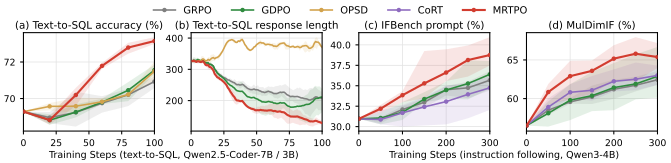
⚡ MRTPO learns faster
97%
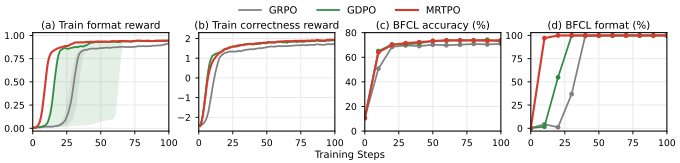
BFCL cases in the required tool-call format after 10 training steps, vs 2% for GDPO and 4% for GRPO
13 steps
median to a format reward of 0.8, vs 19 for GDPO and 34 for GRPO
60 / 100
steps for Coder-7B to pass GDPO's final text-to-SQL accuracy
200 / 300
steps for Qwen3-4B to pass every baseline's final IFBench accuracy
Tool calling: training format and correctness reward, and BFCL accuracy and format, over training.Text-to-SQL accuracy and response length; IFBench and MulDimIF accuracy over training. Text-to-SQL responses
become 40% shorter than GDPO's with Coder-3B.
05 · Analysis
🔍 Where the credit goes
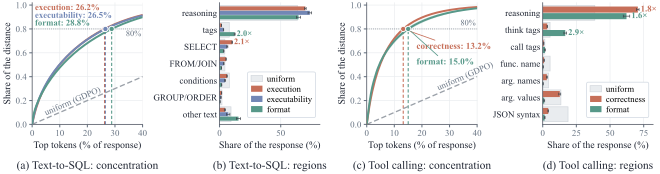
Each reward's distance concentrates on a small part of the response. In text-to-SQL, 80% of a reward's distance falls
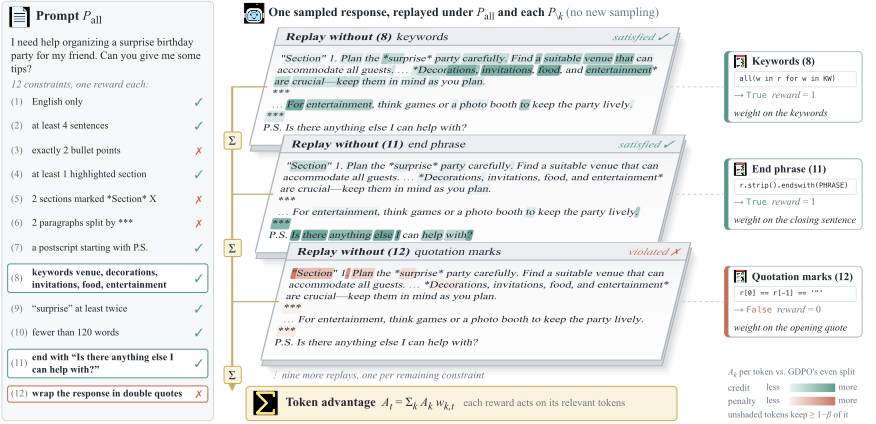
on 26–29% of the tokens; in tool calling, on 13–15%. In instruction following, an end-phrase constraint puts
40% of its distance on 4% of the tokens: the phrase itself.
Share of each reward's distance on the top tokens, and on each region of the response, for text-to-SQL and tool
calling. GDPO's uniform split is shown for reference.
Tool calling
Self-replay on a tool-calling response with a correctness block and a format block.
Instruction following
Self-replay on an instruction with 12 constraints, one reward each. Each replay removes one constraint from the
prompt.
06 · Apply to your task
🧪 Using MRTPO on your own task
MRTPO needs two things from a task:
1 · Rewards
A vector of rewards, each scored by its own verifier, as in GDPO.
2 · Verifier blocks
For every reward, a text block that carries the information its verifier uses. The two replay contexts differ
only in this block, so the block decides which tokens receive the reward's advantage.
Building the two contexts
For each reward \(k\) the replay compares \(P_{\text{all}}\), which contains the blocks of all rewards, with
\(P_{\setminus k}\), the same context with block \(k\) removed.
The prompt does not show it
Tool calling, text-to-SQL. The verifier holds information the policy never sees while sampling: the reference calls, the
reference query, the response's own SQLite error. Write each piece as a block and append the blocks to the rollout prompt
\(P_0\): \(P_{\text{all}} = P_0\) + all blocks, \(P_{\setminus k} = P_0\) + all blocks except block \(k\). The rollout
itself still uses \(P_0\).
The prompt already shows it
Instruction following. Every constraint the verifiers check is part of the instruction, so the rollout prompt is
already \(P_{\text{all}}\). Nothing is added; \(P_{\setminus k}\) is the rollout prompt with constraint \(k\)
deleted.
Writing a block
One reward, one block. Never merge several constraints, rubric items or verifiers into one.
Write the information itself, specific to this example. Build every block by code from the example's label or
the verifier's own output; a generic requirement ("the query must execute") carries no information.
Write it as a plain statement, like the rest of the prompt. No instructions to the model, headings, labels, or
words about training, replay or scoring.
Use only this response's own feedback. If there is none, the block is empty; never invent one.
Write references in the form the policy is asked to produce, with the same tags, code fences and argument types.
Keep the prompt, the rewards and the blocks consistent, and replay the rollout prompt and the response exactly as
sampled.
Which rewards fit
MRTPO helps when a reward's information, written as text, changes what the policy would write at the positions its
verifier reads: a tool name and its arguments, a table or column, a required phrase. In math reasoning, the answer block
points only at the last number, and a length limit is not decided by particular tokens. We did not evaluate MRTPO on math
answer and length rewards or on GDPO's coding rewards.
Hyperparameters
β = 0.5 works in all our settings and is a good default; some tasks may prefer a smaller β. The reallocation bound keeps
long training runs stable, so we use it in all settings. For short training, MRTPO without the bound also works well
(--no-reallocation-bound).
Before trainingreplay_viz/ replays responses of the base
model under your blocks and draws each reward's token weights. If you are unsure whether a block works, look at a few
responses there first. Full guide: the README on GitHub.
Citation
BibTeX
@article{zhai2026mrtpo,
  title   = {Each Reward to Its Relevant Tokens: Reward-Specific Token-Level
             Credit Assignment for Multi-Reward {RL}},
  author  = {Zhai, Skylar and Wang, Haonan and Liu, Zhining and Song, Linxin and
             Ding, Xuwei and Liang, Jingcheng and Kang, Jian},
  journal = {arXiv preprint arXiv:2610.21439},
  year    = {2026}
}